
Workforce Planning in the AI Era: How Creative Agencies Must Rethink Skills, Capacity and Collaboration
Creative and media agencies are operating under extraordinary pressure. Deadlines keep accelerating, margins are getting tighter, talent markets are shifting faster than teams can respond. This pressure is forcing a fundamental rethink of workforce planning in the AI era - not as a headcount exercise, but as a question of how human creativity, AI systems and automation work together to deliver value at speed.
With generative AI entering almost every tool stack, access isn’t the problem anymore, impact is. AI usage is inconsistent, confidence is low, and leaders are rightly asking for ROI, not experiments. In practice, this gap shows up as sluggish adoption, unclear skills strategies, and a growing discomfort about using AI responsibly.
It’s no surprise that recent research from McKinsey’s State of AI 2025 report points to the same conclusion: organizations don’t see meaningful value from AI until they redesign workflows, decision-making and capability models. To unlock real performance gains, we must shift to capability orchestration - bringing humans, AI and automation together in a coherent, well-governed system.
Written for HR and talent leaders, this article explains how workforce planning in the AI era is changing for creative and media agencies, shifting from static headcount models to capability-based planning, human–AI collaboration and workflow orchestration.
For a broader perspective on how AI is expected to reshape work, skills and organizations over the next decade, you may also find our whitepaper AI: Preparing for 2030 useful.
1. Why AI Tools Aren’t The Problem
What we’re witnessing is not a tooling issue, but a deeper AI workforce transformation in creative agencies, where roles, skills and workflows are no longer static or linear. Today’s teams operate inside fluid, blended environments where:
- Humans and AI tools work side by side
- Task loads shift from month to month
- Core skills are more dynamic than ever (WEF 2025)
- Workflows run non-linearly across systems
In this reality, the workforce question is evolving. It’s no longer “Who will do this task?” but rather: “Which form of intelligence (human, AI copilot, automation or a combination) is best suited to this moment?”
Organizations that continue planning around headcount instead of capability will struggle to scale, adapt and compete. What we need is a clear, accessible language for how work is delivered in an AI-native environment.
2. A Human–AI Collaboration Model for AI-Native Work
AI adoption stalls when teams are unsure how to use it or when it’s appropriate. To create clarity, agencies need a shared human–AI collaboration model; a practical way to describe how creative work is produced when humans and AI operate side by side. The six “modes of intelligence” framework is one that enables reflection on how work is actually produced.
- Mode 1: Pure Human Creativity - when the work must be born, not built. This is emotional truth, brand narrative, cultural nuance - areas where AI cannot lead.
- Mode 2: AI-Amplified Creativity - the idea is human; AI improves clarity, scale or speed.
- Mode 3: AI-Augmented Collaboration - the “creative duet.” Humans and models ideate, iterate and refine together.
- Mode 4: Applied AI Automation - tasks that are rule-based, repeatable and data-driven.
- Mode 5: Agentic AI Systems - multiple AI systems working together toward a shared objective.
- Mode 6: Full Automation - autonomous systems maintaining tempo, stability and uptime.
This model removes uncertainty. It helps teams understand boundaries, build confidence and adopt AI responsibly, without losing the human-led essence of creative work.
3. How AI Changes the Work: Redesigning Creative Workflows
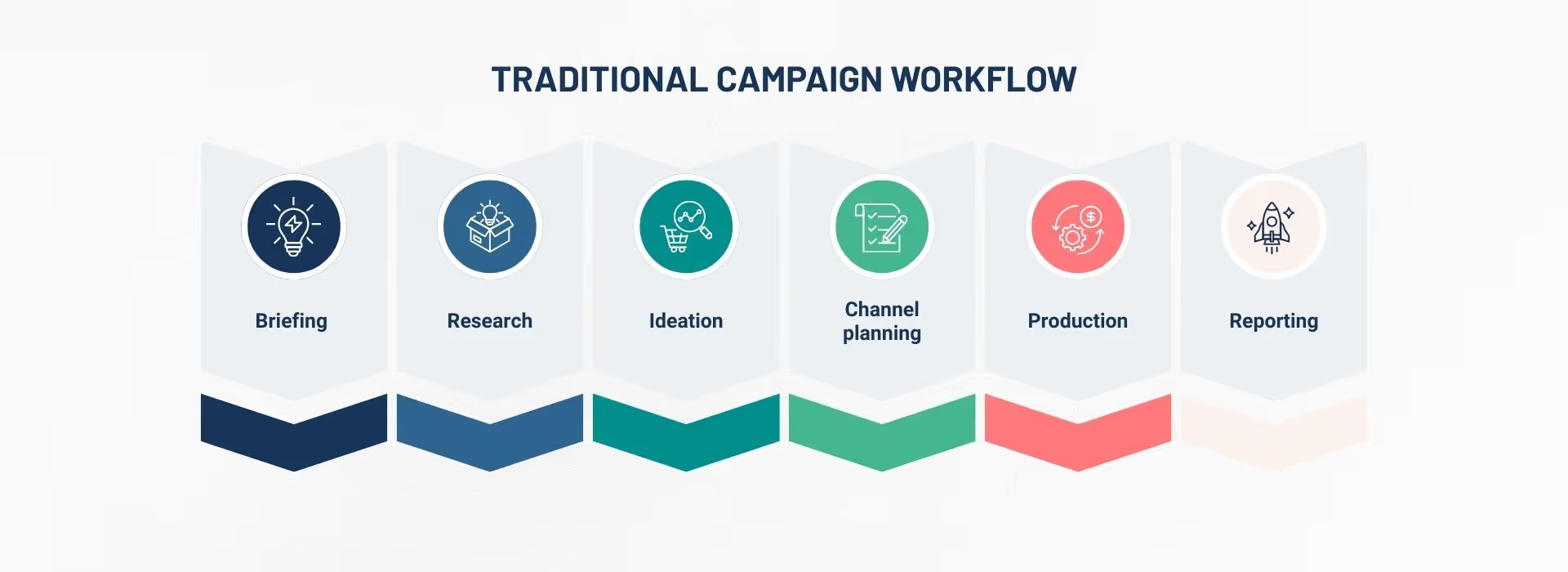
To make AI adoption real, workflows must evolve, not just software. Consider the traditional workflow for developing a campaign strategy:
Briefing > Research > Ideation > Channel planning > Production > Reporting
It works, but it’s slow, sequential and heavily dependent on individual bandwidth. Every step waits for the step before it, which constrains scale and agility.
Now consider the AI Workflow (Human + AI Orchestration). Instead of replacing creativity, AI removes friction leaving us humans free to do more of what only humans can do!
- Intelligent Briefing - AI extracts constraints, summarises client history and highlights priorities → Humans apply judgment and nuance.
- AI-Augmented Insight Generation - AI synthesizes trends and signals → Humans validate meaning and narrative.
- Concept ideation - Creative leads co-create with AI, exploring multiple concept directions in minutes.
- Data-Driven Channel Design - Agentic systems coordinate spend, timing and platform orchestration.
- Scaled Production - Automation handles resizing, variations, localisation under creative guidance.
- Continuous Optimisation - AI agents test, refine and iterate in real time.
BGC research shows that organizations redesigning workflows with AI see up to 26% higher productivity gains through saving time, more focus on strategic work and the ability to make better decisions, than those who simply “add tools”. This shift reflects the future of workforce management, where value comes not from rigid processes, but from orchestrating intelligence across people, systems and automation.
4. Capability-Based Workforce Planning in the AI Era: The 4B Model
As AI reshapes work, leaders are asking new questions: Do we hire for this? Train for it? Outsource it? Automate it?
A recent summary from Harvard Business argues that with AI-driven role changes, organizations must adopt “nonlinear” AI workforce planning, forecasting future capability needs, not just plugging current skills gaps.
The 4B capability model supports a shift toward capability-based workforce planning, helping leaders make faster, more rational decisions in an environment where roles and demand are constantly evolving.
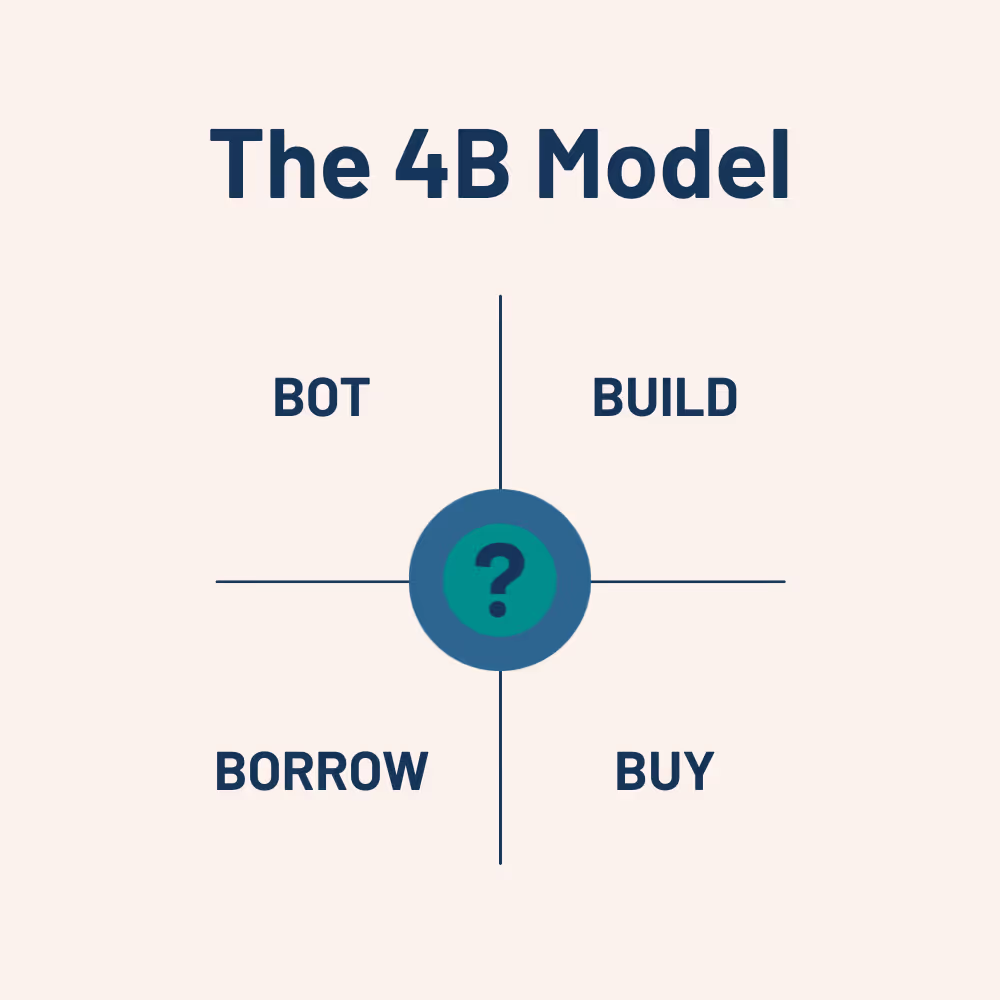
1. BOT (Automate It)
For rule-based, repetitive, high-volume tasks. Examples: reporting, asset generation, scheduling, compliance.
2. BUILD (Develop Internally)
For core creative identity and long-term value. Examples: creative direction, ethical governance, cultural insight, AI prompting.
3. BORROW (Bring It In When Needed)
For demand spikes or niche expertise. Examples: freelance designers, data scientists, partner agencies.
4. BUY (Secure It Permanently)
For leadership, deep expertise or foundational systems. Examples: senior creative leaders, Heads of Partnerships, licensing AI infrastructure.
This model creates clarity in a landscape where roles, skills and workflows are all in motion.
5. Building Trust and Confidence Through Light-Touch AI Governance
According to Major Players 2025 Research into AI in the Creative Industries, “When leaders push ahead without creating the conditions for people to adapt, organizations end up pursuing change they aren’t equipped to deliver, heightening anxiety instead of enabling progress.” Employees want to use AI, but they want to use it safely. And effective governance doesn’t need to be heavy. In fact, it must be the opposite: simple, transparent, practical, human-centred.
Three guardrails keep things aligned without slowing teams down:
1. Ethical Clarity
Which tools are approved? What data is acceptable? Where is human sign-off required?
2. Experiential Quality
Are outputs human, on-brand and emotionally resonant?
3. Effectiveness Calibration
Are we checking for drift, bias, hallucination or tone misalignment?
Governance becomes a metronome - steady, reliable, and confidence-building to keep everything in rhythm.
6. A Practical Action Plan for Workforce Planning
You don’t need a 200-page transformation plan. You need one workflow, one skill mapping exercise, and one governance conversation.
Here is the simplest path forward:
Step 1: Choose one high-value workflow
Campaign strategy, content production, briefing, QA - whatever is most feasible.
Step 2: Map the six modes of intelligence
Define where humans lead, where AI copilots help and where automation fits.
Step 3: Identify capability needs
List the top 5 human and AI capabilities needed per stage. This becomes the start of your AI skills strategy.
Step 4: Apply the 4B model
Which capabilities should you build, borrow, buy or bot?
Step 5: Add the three guardrails
Ethics, quality and calibration.
Step 6: Measure one clear outcome
In practice, agencies can track progress by measuring reduced cycle times, improved margin control, faster iteration through creative variations, and increased confidence in responsible AI use. Start with one metric tied to a single workflow, review it monthly, and expand only once the results are consistent.
Consistency builds credibility. Credibility builds momentum. This approach provides a practical starting point for workforce planning in the AI era, without requiring large-scale reorganization or heavy governance.
Conclusion: The Future of Work - Rethinking Workforce Planning
“When human and AI intelligences play in harmony, it’s the siren song of the future we hear.” (Adam Hopewell). Organizations that succeed at workforce planning in the AI era will be those that can align human creativity, AI copilots, agentic systems and automation within a coherent, trusted operating model - without losing what makes creative work human.
Key Takeaways for Workforce Planning in the AI Era
- Workforce planning is shifting from roles to capabilities.
- Human–AI collaboration requires clear modes, not vague expectations.
- Workflow redesign drives more value than adding tools.
- Capability-based planning enables faster, less emotional resourcing decisions.
- Light-touch governance builds trust and adoption without slowing teams down.
Looking further ahead
If you’re thinking beyond immediate adoption and want to understand how AI will reshape skills, roles and organizational design over the rest of the decade, our whitepaper AI: Preparing for 2030 explores what leaders should be planning for now.
👉 Download the whitepaper: AI – Preparing for 2030
Education is the backbone of the workforce evolution. At Edifai, we work with agencies to support workforce transformation through AI education, helping them build shared AI literacy and blend human expertise with digital capability that is vital for flexible talent systems.
If you’re ready to build the skills and culture needed to adapt fast, stay creative and deliver sustained and scalable impact, we’d love to talk - Book a Call.
Taken from our webinar “The Art of Workforce Planning - How Agencies Can Keep Pace In The AI Era” with Adam Hopewell. Adam has spent 15+ years helping global organizations adopt AI responsibly, including leading AI-enabled talent transformation at Behav.
Related resources
.png)
The L&D Leader's Claude Playbook
.avif)

%201.svg)

